Center for Research on the Origins of Art and Religion
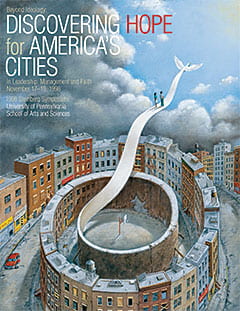 In 1998, Penn'southward School of Arts and Sciences (SAS) sponsored a three-twenty-four hour period Steinberg Symposium, "Take Faith in the Urban center," featuring then Princeton Professor John J. DiIulio, Jr. The interest and turnout by a diverse array of Penn faculty members, staff members, and students far exceeded all expectations. The events were also attended by hundreds of leaders and citizens associated with Philadelphia's more than than 2,000 urban religious congregations.
Penn recruited DiIulio to institute, develop, and straight each of two divide simply related new programs within SAS, the Robert A. Fox Leadership Plan, known equally Fox, which launched in 1999, and the Center for Enquiry on Religion and Urban Civil Social club (CRRUCS), which launched in 2000. CRRUCS was established with a Pew Charitable Trusts "Centers of Excellence" grant. In return for about $5 one thousand thousand in Pew support, Penn-SAS agreed to dedicate to CRRUCS in perpetuity a sizable fraction of office and common space in the historic circuitous at 3814 Walnut Street that in 2015 was dedicated as The Robert and Penny Flim-flam Family unit Pavilion, and also a fraction of its chaired senior kinesthesia director's teaching and enquiry fourth dimension.
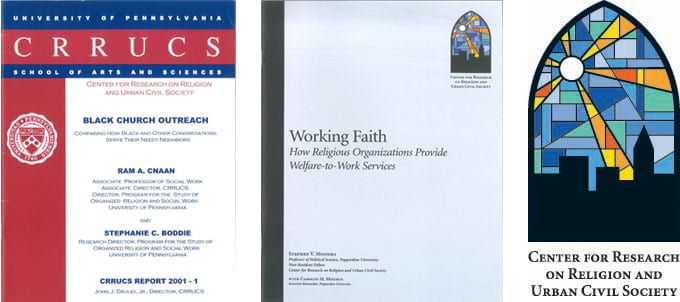
During its beginning four years, CRRUCS focused mainly on producing and disseminating professional empirical research. Much of the CRRUCS era research focused either on the "faith gene" in relation to civic outcomes or on the extent to which urban religious congregations and other faith-based nonprofit organizations, both local and national, delivered diverse social services to low-income children, youth, families, and communities. During that menstruum, DiIulio took an early leave of absence to serve equally Assistant to the President of the U.s.a. and the first Director of the White House Function of Faith-Based and Community Initiatives.

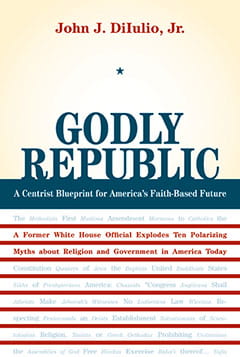 Encouraged to do and so by successive cohorts of the Penn students in his pop Political Science 240 seminar, "Religion, Nonprofit Organizations, and U.S. Public Policy," DiIulio summarized the early on empirical research, exposed several myths about church-state history, and chronicled his experiences as "first faith czar" in Godly Republic: A Centrist Blueprint for America's Faith-Based Future (University of California Printing, 2007).
DiIulio went on to assist the Obama assistants in reconstituting his quondam office as the White Firm Function of Faith-Based and Neighborhood Partnerships, and in expanding its affiliated centers to all cabinet agencies and the Corporation for National and Community Service.
In the mid-2000's, in response to growing Penn undergraduate student interest, CRRUCS was recast into PRRUCS—the Program for Research on Religion and Urban Ceremonious Club.
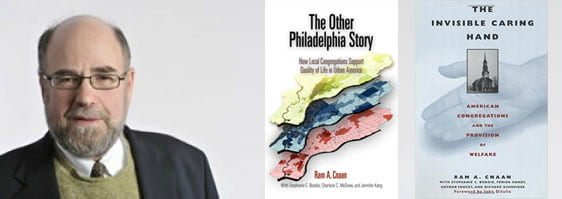
CRRUCS had focused mainly on policy-relevant academic research, virtually notably, the path-breaking inquiry by PRRUCS Resident Senior Fellow Dr. Ram Cnaan of Penn'south School of Social Policy and Practise on urban community-serving religious ministries. PRRUCS retained the commitment to such research merely focused ever more on engaging Penn undergraduates and faculty members across the natural sciences, the social sciences, and the humanities in a wider range of religion-relevant studies, courses, and special events.
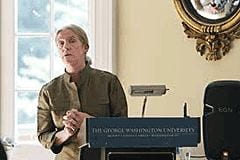 With the strong encouragement of Pew's religion program officials, and under the leadership of then SAS Dean of the College (and later SAS Dean of the Kinesthesia), Dr. Rebecca Bushnell, during just its first iii years, a PRRUCS faculty steering commission, along with faculty consultants drawn from physics to philosophy, supported the evolution of more than three dozen religion-relevant Penn undergraduate courses.
More a dozen years later, most of those PRRUCS-sponsored courses were notwithstanding being offered, many of them among the most widely popular courses in the College of Arts and Sciences.
In 2015, on the fifteenth anniversary of PRRUCS, Penn President Amy Gutmann dedicated the beautifully renovated circuitous at 3814 Walnut Street equally The Robert and Penn Fox Family Pavilion. Honoring the "Center of Excellence" agreement that brought the original plan into being, PRRUCS was guaranteed office infinite in the Leadership Hall basement suite and on its second flooring.
In 2020, when PRRUCS celebrated its twentyth anniversary, it was already three years into the initiative that, thanks to the vision and generosity of Penn alumnus James N. Perry, Jr., C'82, volition still exist central to the program's piece of work when information technology celebrates its 30th ceremony in 2030—the Perry-Collegium Constitute project.


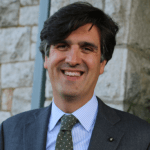
James N. Perry Jr., Francis J. Hager, Vincenzo La Ruffa
In 2021, Perry, joined by 2 other generous and visionary Penn alumni, Francis J. Hager West'79 and Vincenzo La Ruffa C'02, created a x-twelvemonth fund ensuring that PRRUCS, led by its Executive Director, Dr. Daniel Cheely GR'15, will be able to brand the Perry-Collegium Institute projection flourish along with four other initiatives, each of which continues or complements work begun or done past CRRUCS/PRRUCS during its preceding eras:
- Common Ground for Mutual Adept (C2G2)
- Sacred Places/Civic Purposes
- Partnership for Empirical Studies and Surveys (PESS)
- Global Religion and Transnational Religious Organizations
Source: https://prrucs.upenn.edu/history/
0 Response to "Center for Research on the Origins of Art and Religion"
Post a Comment