Buy Smoke Beef Sausage Natural Casing
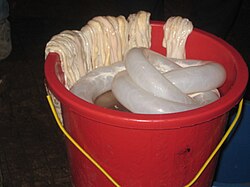
Casing from beef (in saucepan) and sheep (on rear edge of bucket)
Sausage casing, also known as sausage pare or simply casing, is the cloth that encloses the filling of a sausage. Natural casings are made from animate being intestines or peel; artificial casings, introduced in the early 20th century, are made of collagen and cellulose.[1] The textile is and then shaped via a continuous extrusion process – producing a single sausage casing of indefinite length – which is then cut into desired lengths, ordinarily while the extrusion process continues.
Natural casings [edit]
Origin [edit]
Natural sausage casings are made from the sub-mucosa of the pocket-size intestine of meat animals,[2] a layer of the intestine that consists mainly of naturally occurring collagen.[iii] In Western European cuisine and Chinese cuisine, almost casings come up from pigs, just elsewhere the intestines of sheep, goats, cattle and sometimes horses are also used. To set the intestines every bit casings, they are flushed, scraped and cleaned with water and salt by hand or with machinery; today they are primarily automobile cleaned. The outer fat and the inner mucosa lining are removed during processing.[3] They are salted to lower the water activity (which inhibits microbial growth) and preserve the casing.[3] Natural casings have been used in the production of meat specialties for centuries and have remained virtually unchanged in role, appearance, and composition. US and EU organic food regulations only let natural casings, they can exist derived from non organically raised animals as there are no big calibration slaughter plants which handle and procedure merely organic animals and sell their casings as certified organic casings. Every bit a result all large scale natural casing companies purchase casings from around the world and transport them to their selection facilities to exist graded and packaged. There are 4 primary brute genera which are used to manufacture natural casings (although all mammals raised for meat could potentially be used to produce natural casing): cows, pigs, and lambs and sheep.
Appearance [edit]
Natural casing sausages are distinguishable from collagen or cellulose casings because of their irregularity, although high quality sheep and lamb casings tin can be almost indistinguishable from a collagen casing as they have no noticeable imperfections. The master difference is in the way they are twisted and linked which impacts the appearance of the final production and makes it piece of cake to differentiate a hot dog using natural sheep or lamb casing vs collagen casing. The size and usage of natural casings are impacted by the creature they are derived from, the narrowest being lamb followed by sheep followed by pig followed past beef. The size range for lamb is xiv mm to 28 mm in diameter (which is how casings are graded), the size range for sheep is xvi mm to 32 mm in diameter, the size range for squealer is 28 mm to 58 mm in diameter, the size range for beef is 43 mm to 65 mm, although beefiness hurl caps (which are not derived from the small intestine) have a size range of 115 mm to 130 mm.[3]
Processing [edit]
The process begins at the slaughter plant where "green" (uncleaned) runners (ungraded casings) are removed from the animate being during the slaughter process and they are later cleaned, which involves breaking the inner mucosa usually with a motorcar that they become through and rollers suspension the inner mucosa so information technology tin be flushed out and removed. The cleaning procedure can also exist done by hand but primarily casings are machine cleaned. This is a very water intensive procedure as the casings are vigorously flushed with cold water to remove blood from the mucosa which if non properly flushed during the initial processing tin atomic number 82 to "staining" of the casing where it becomes pink. The cleaned runners are then tied in bundles and packed in plastic drums and filled with a saturated salt brine for preservation. The runners are so sold to the company which processes natural casings by grading and packaging them to create finished units called hanks.

Natural casings are produced and sold nearly exclusively by the hank which is a unit of measure that is 91 meters long.[iii] A hank tin can consist of a varying number of strands (private pieces of casing) which vary in length from 2 meters (which is the shortest length sold for commercial use) to as long as 28 meters. Each casing manufacturer has various "put ups" which dictate the maximum number of strands and the minimum length of each strand allowed in the put up. Casings are selected for size which is measured in millimeters and refers to the bore of the casing, this is washed exclusively by hand and is primarily done in China due to the availability of low cost labor. Commercially casings are available in diverse forms of packaging which are suited to unlike applications. Sheep/lamb and pig are available in all packaging types due to the high demand and long length of pieces, due to the shorter length and much lower demand for beef casings they are primarily but available loose or in net packs either salted or in brine.
Packaging [edit]

Hog casings, packed in common salt, from a vacuum pack
Sheep and lamb and hog casings are available "tubed" where each strand is put on a plastic tube which allows the sausage maker to hands place the casing on the stuffing horn,[iii] in recent years these tubes take been modified so they intermission open along a seam and the operator can pull them out at the dorsum of the horn allowing greater efficiency; these are referred to in the industry as "zip tubes", due to the attachment like nature of the seam. These tubed casings are then packed in plastic nets usually two per net and packed in plastic drums which are so filled with a saturated salt brine, usually 200 per pulsate. These are available in all diameters and in lengths greater than 3 meters (as two meter or shorter pieces are price prohibitive to tube).
Sheep and lamb and hog are also available loose in brine in a vacuum sealed plastic pack, commonly referred to as "vacuum packs", these are primarily used by small to medium sized sausage makers who use less than 100 hanks per month of casing. The entreatment of vacuum packs is the ease of employ, their shorter strand length for paw stuffing (all sausage makers who don't use automated sausage stuffing and linking machines) and their shelf life, they only need to be opened as needed so the sausage maker doesn't need to worry that they won't utilise their opened casings prior to a subtract in quality. These are available in all diameters and in put ups from curt up to medium length, almost 6 meter minimum, with a maximum length of about 14 meters.
Sheep and lamb and hog are also bachelor in a internet, commonly referred to as net pack, these are bachelor salted or in alkali and they are primarily used by medium to large sausage makers who do not want to pay the additional cost for the tubed casing and don't have automatic sausage stuffing and linking machines (which require tubed casings to operate efficiently). These are available in all diameters and in lengths greater than 2 meters (as that is the shortest length sold for commercial use).
Beef casings are primarily bachelor only salted or in brine, they are measured in sets not hanks and the length is 32 meters, this is for beef "rounds" and "middles" only, beef hurl caps are merely about 1 meter in length.
Artificial casings [edit]
Artificial casings are made of collagen (often derived from cattle pare), cellulose, or plastic. Artificial casings from animal collagen are generally edible, though some are not.
Collagen casings [edit]
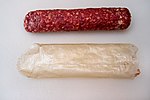
A salami and the collagen casing (beneath) it came in
Collagen casings are mainly produced from the collagen in beef or pig hides,[2] and the bones and tendons. It tin can also exist derived from poultry and fish. They have been fabricated for more than 50 years and their share of the market has been increasing.[4] [5] Ordinarily the cost to produce sausages in collagen is significantly lower than making sausages in gut because of college production speeds and lower labor requirements.
The collagen for artificial casings is processed extensively. It is formed by extrusion through a die to the desired diameter, dried and shirred into short sticks upward to 41 cm (16 in) long that contain as much as 50 m (160 ft) of casing. In a newer procedure, a course of dough is coextruded with the meat blend, and a blanket is formed past treating the outside with a calcium solution to fix the coating.
The latest generation of collagen casings are usually more than tender than natural casings but practice not exhibit the "snap" or "bite" of natural casing sausages. Near collagen casings are edible, just a special course of thicker collagen casings is used for salamis and big caliber sausages where the casing is usually peeled off the sausage by the consumer. Collagen casings are less expensive to use, give better weight and size control, and are easier to run when compared to natural casings.
Vegetarian casings [edit]
Some innovative coextrusion processes have been developed in recent years, allowing 100% found-based vegetarian casings to exist created. Some special alginate coextrusion equipment is required to brand casings that tin be used in halal or kosher nutrient making.[ citation needed ]
Inedible casings [edit]
Casings made from cellulose and plastics are peeled off food products and are not eaten.[2]
Cellulose casings [edit]
Cellulose, usually from cotton linters or wood pulp, is candy to brand viscose, which is then extruded into articulate, tough casings for making wieners and franks. They also are shirred for easier use and tin can exist treated with dye to brand "red hots". The casing is peeled off subsequently cooking, resulting in "skinless" franks. Cellulosic viscose solutions are combined with woods or for example abaca lurid to make large bore fibrous casings for bologna, cotto salami, smoked ham and other products sliced for sandwiches. This type is also permeable to smoke and water vapor. They can exist apartment or shirred, depending on awarding, and tin can exist pretreated with fume, caramel color, or other surface treatments.
Plastic casings [edit]

Plastic casings in employ at Bilyan Factory, Armenia (2007)

Plastic casings are not eaten.[2] They also can exist flat or shirred. Generally, smoke and water tin can not pass through the casing, so plastic is used for non-smoked products where high yields are expected. The inner surface can exist laminated or co-extruded with a polymer with an affinity for meat poly peptide causing the meat to stick to the moving-picture show, resulting in some loss when the casing is peeled, merely higher overall yield due to meliorate moisture control.
Plastic casings are by and large made from polymers such as polyamide, polypropylene, or polyethylene. Polyamide (Nylon) plastic casings are the near normally used in production of cooked sausages and hams such as luncheon meat and bologna. Polyamide casings come up in two main varieties: Oriented and non-oriented. The oriented polyamide[6] are shrinkable casings and will shrink during the cooking process thereby reducing the water loss. Non-oriented polyamide casings remain the same diameter during the cooking process and thereby permit for expansion of the meat during cooking. The use of polyamide casings has expanded recently with the appearance of various varieties and structures of casings such as multilayer casings.[7]
References [edit]
- ^ "A Cursory History of Natural Casings". The International Natural Sausage Casing Association (INSCA). 2006. Archived from the original on June 15, 2010.
- ^ a b c d "AskUSDA". United States Department of Agriculture.
- ^ a b c d east f Rust, R.E.; Knipe, C.50. (2014). "Sausage Casings". Encyclopedia of Meat Sciences. pp. 235–240. doi:10.1016/B978-0-12-384731-7.00137-ix. ISBN9780123847348.
- ^ "Agreement Collagen Casings | LEM Products | The Leader In Game Processing". lemproducts.com.
A natural protein product, collagen comes from a layer of beefiness hide, removed and refined. The more refined the processing, the more tender the casing.
- ^ "What are Collagen Casings? How Are Collagen Casings Produced?". askthemeatman.com.
- ^ Vicik, Stephen James (Dec 11, 2002), A heat shrinkable polyamide sausage casing with a polyolefin cadre layer , retrieved 2016-eleven-10
- ^ U.S. Patent 4,243,074
Source: https://en.wikipedia.org/wiki/Sausage_casing
0 Response to "Buy Smoke Beef Sausage Natural Casing"
Post a Comment